
China runs on QR codes. Street stalls, taxis, metro gates, museum tickets and hotel deposits are routinely paid by phone, and a foreign credit card on its own is rarely enough. The good news: you do not need a Chinese bank account or a Chinese phone number. You need a passport, an international card, and about fifteen minutes on Wi-Fi before you fly.
01Why This Is the First Thing to Set Up
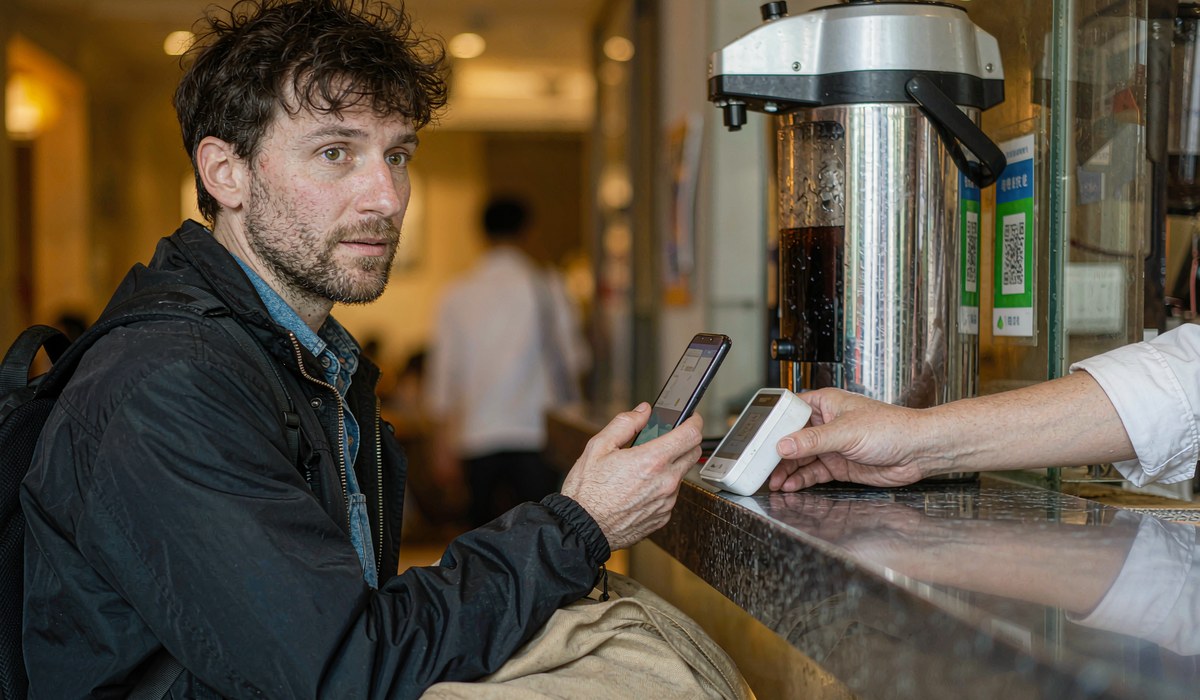
Mobile payment is the default in most Chinese cities. A noodle shop may have no card terminal, a taxi driver may not carry change, and a metro gate may only accept a transit QR code. Arriving without a working wallet does not strand you, but it turns every small purchase into a negotiation.
Since 2023 both Alipay and WeChat Pay opened their merchant networks to internationally issued cards. You can now register with a foreign mobile number, verify your identity with a passport, link a Visa or Mastercard, and pay at the same QR codes locals use. Neither platform requires a Chinese bank account.
- Do the setup at home on stable Wi-Fi, not at the airport on roaming data
- Install both apps: the second one is a genuine backup when a card is declined
- Keep 200–500 CNY in small notes for markets, old taxis and a dead phone battery
02What you need before you start
Gather everything first. The two most common reasons verification stalls are a passport photo with glare on the machine-readable zone, and a name that does not exactly match the cardholder name on your bank's records.
It is also worth calling your bank before you travel. Cross-border wallet tokenisation is sometimes blocked by default fraud rules, and a short note on the account prevents the first transaction being declined.
- A passport valid for your whole trip (or a Foreign Permanent Resident ID Card)
- An internationally issued Visa, Mastercard, JCB, Discover or Diners Club card; WeChat Pay also lists American Express and overseas UnionPay
- A mobile number that can receive SMS — international numbers work, no Chinese SIM is required
- An email address, and a six-digit payment password you have not used as a phone unlock PIN
- Good front-facing light for the facial recognition step
03Alipay: Register Step by Step
Download Alipay from the official App Store or Google Play listing published by Ant Group. Tap Sign Up, choose your country code, enter your foreign mobile number and confirm the SMS code. The app has a complete English interface and switches automatically for overseas numbers.
Next, complete identity verification (listed as 'Real-Name Authentication' in some apps): open Me → Account and Security → Identity Information (or the Identity Verification prompt), choose the non-mainland resident / passport route, and upload a clear photo of the passport biographical page with the two machine-readable lines fully visible. Enter your passport number and expiry exactly as printed, then complete the on-screen facial recognition in even light. Approval is usually minutes, but allow up to 24–72 hours.
Once verified, go to Me → Bank Cards → Add Card, enter the card number, expiry and CVV, and confirm the small validation charge or 3-D Secure code your issuer sends. Set a six-digit payment password when prompted. You are now ready to pay.
- Order matters: verify identity first, then bind the card
- The name on the card must match the passport name used for verification
- Alipay's Transport (出行) section also issues metro and bus QR codes for many cities
04WeChat Pay: Register Step by Step
WeChat Pay lives inside WeChat; there is no separate wallet app. Install WeChat, register with your international number, and confirm the SMS code. Occasionally a new account needs an existing WeChat user to confirm a security prompt — if that appears, ask your hotel, a colleague or a local contact, or try the in-app alternative verification path.
Open Me → Services → Wallet. If Services is hidden for a brand-new overseas account, a first payment attempt or the WeChat Pay official account prompt usually enables it. Go to Identity Information → Real-Name Authentication and choose passport, upload the photo page and complete the face check. Then Wallet → Bank Cards → Add a Card, enter the card details and billing address, and complete the issuer's 3-D Secure or SMS confirmation.
WeChat's English coverage is partial compared with Alipay, and its billing-address matching can be strict. US, UK and EU-issued cards tend to pass most smoothly; if a card is refused, try a different network rather than repeatedly retrying the same one.
- Wallet → Cards → Add Card is the reliable path for overseas cards
- A small pre-authorisation charge may appear briefly, then reverse
- Passport-only users can pay merchants; red packets and balance features need extra verification
05The two ways you will actually pay
Scan to pay: open the app, tap Scan (扫一扫), point at the merchant's printed QR code, type the amount yourself, check it on screen, then confirm with your payment password or Face ID. This is the common flow at small shops and market stalls.
Show to pay: tap Pay / Receive (付款码) and let the cashier scan the barcode on your screen. Supermarkets, pharmacies, restaurants and hotel desks use this. The code refreshes continuously, so never screenshot it or send it to anyone.
- Always type or confirm the amount yourself when scanning a static sticker code
- Keep the phone unlocked and the screen bright for the cashier's scanner
- A receipt for every transaction is stored in the app's bills section
06Fees, Limits and What They Mean in Practice
For internationally issued cards, a single transaction of 200 CNY or less is normally free of service charge. Above that threshold the platforms apply roughly a 3 percent international card service fee to the full transaction amount, not only the portion above 200 CNY. Splitting a large bill is rarely worth it, but knowing the rule avoids a surprise at checkout.
Spending caps apply to foreign cards. The regulatory ceiling cited in official 2024-2026 guidance is the equivalent of USD 5,000 per transaction and USD 50,000 per year for passport-verified international cards. In practice each platform applies its own lower limits: publicly documented 2026 figures put WeChat Pay around 6,000 CNY per transaction and fully verified Alipay around 35,000 CNY, while unverified accounts are capped much lower. Treat the number on your own app card payment-limit page as authoritative, and check it before a large hotel or shopping payment.
- Under 200 CNY: generally no international card service fee
- Over 200 CNY: about 3 percent on the whole amount
- Large purchases: check the in-app limit page, or pay by card at a hotel front desk
- Both wallets bound to the same card give you a second route if one is rate-limited
07Where you will use it beyond shops
Alipay's Transport section issues city metro and bus QR codes after a quick identity check, and its ride-hailing mini-apps cover taxis and Didi in most cities. The 12306 English site and app accept passport verification for high-speed rail tickets and take Alipay, WeChat Pay and UnionPay at checkout. Hotels, attraction bookings, convenience stores and hospital registration desks are overwhelmingly QR-based.
Some overseas e-wallets — including AlipayHK, mPay (Macao), Touch 'n Go (Malaysia), Kakao Pay and Toss (Korea), TrueMoney (Thailand) and Changi Pay (Singapore) — can now be used directly at mainland merchant codes. If you already have one, check whether your home wallet is on the supported list before installing anything new.
- Metro and bus: Alipay → Transport → choose your city
- Trains: 12306 English version, passport verification, pay by Alipay or WeChat Pay
- Ride-hailing: Didi accepts foreign numbers and foreign cards inside its own app too
- Cash remains legal tender — small vendors must accept it, though change can be slow
08When Something Fails: A Troubleshooting Order
Work through these in order rather than retrying blindly. Most failures are on the issuing bank's side, not in the wallet. A declined binding is usually a blocked cross-border tokenisation request; a declined payment after a successful binding is usually a 3-D Secure or daily-limit rule.
If the passport upload keeps being rejected, retake the photo on a dark, non-reflective surface with all four corners visible and no fingers over the coded lines. If facial recognition fails repeatedly, switch to bright indirect daylight and remove glasses or a hat.
- Card refused at binding: call the issuer, ask them to allow Alipay / WeChat Pay tokenisation and enable 3-D Secure
- Name mismatch: use exactly the Latin-script name on the card, including middle names
- Payment declined: check the in-app per-transaction limit and your issuer's overseas daily cap
- No data connection: QR payment needs a network — carry cash and an offline map
- Phone lost: use the platform's web or hotline remote-freeze option immediately
09Security and Privacy Habits
Set a distinct six-digit payment password, enable Face ID or fingerprint confirmation, and never share your payment code or SMS verification codes. Only scan codes displayed by the merchant you are paying; a QR sticker pasted over another sticker or sent in a message is a classic scam.
Before you leave China, unbind the card in the app if you do not plan to return, and export any receipts you need for expenses. Both apps keep a full bill history, which is useful for corporate reimbursement.
- Never screenshot or share a live payment barcode
- Confirm the amount on your own screen before approving
- Keep 200–500 CNY in cash as the universal fallback
- Unbind cards and review the bill history at the end of the trip
FAQFrequently Asked Questions
Do I need a Chinese bank account?
No. Since 2023 both Alipay and WeChat Pay let overseas visitors bind an internationally issued card after passport verification. A mainland bank account only becomes useful if you are staying long term and want higher limits, red packets or balance transfers.
Do I need a Chinese phone number?
No. An international number that can receive an SMS verification code is enough for registration and card binding on both platforms. A Chinese SIM can make ride-hailing and delivery apps easier, but it is not required for payment.
Which cards are accepted?
Commonly Visa, Mastercard, JCB, Discover and Diners Club; WeChat Pay also lists American Express and overseas-issued UnionPay. Support depends on your issuing bank, so bring a second card from a different network as a backup.
What are the fees?
For foreign cards, transactions of 200 CNY or less are generally free of the international card service fee. Above that, the platforms charge about 3 percent of the full transaction amount. Your own bank may also add a foreign transaction or cash advance fee, so check its terms.
Can I set everything up before I arrive in China?
Yes, and it is strongly recommended. Download both apps at home, complete passport verification over Wi-Fi, bind your card and run one small test payment if your app supports it. You can also use the apps' English-language help centers without being in China.
What if my card keeps being declined?
Ask your issuer to permit cross-border wallet tokenisation and enable 3-D Secure, then wait a few hours and try again. Debit and prepaid cards are refused more often than credit cards. If it still fails, bind a different network or use cash plus an ATM at Bank of China or ICBC.
Is cash still usable?
Yes. Cash is legal tender and small merchants should accept it, but many have little change and some ticket machines are QR-only. Carry 200–500 CNY in 10, 20 and 50 yuan notes for taxis, markets and emergencies.
Ready to find the right person?
Tell us your city, dates and what you need. We'll shortlist 2–3 providers for you to compare.
SRCSources & last reviewed
Rules on payments, entry, transport and health change. This guide was last reviewed on against the official references below. Check the latest guidance before you travel; this article is general travel information, not legal or medical advice.
- Alipay Global — Official Alipay product and wallet information
- Alipay Service Center — Official consumer support and hotlines
- WeChat Pay — Official WeChat Pay merchant platform
- People's Bank of China — Payment regulation and foreign-card rules
Written and reviewed by the SinoCompanion Editorial Team. See how we research, verify and update these guides. Questions or corrections: hello@sinocompanion.com.
This article offers general travel advice. For matters involving health, qualifications or contracts, rely on professional advice and a written agreement between both parties.